Do Lymphatic Leggings Actually Help with Flight Swelling?
This article contains affiliate links. We earn a small commission at no extra cost to you.
Introduction
Fact-checked against cited clinical sources, June 2026. Written and reviewed by the LymphaticLeggingsGuide editorial team. Informational only; not medical advice.
You land at Heathrow after a DXB–LHR rotation and your shoes don't fit the way they did at boarding. That's not in your head. Your legs have been fighting cabin pressure, near-zero humidity, and 10 hours of standing for the past half-day. Lymphatic leggings keep appearing in every FA crew group, but do they actually work, or is it just a well-designed product name? Here's an honest answer.
Why Your Legs Swell at 35,000 Feet
Three things happening at once
Modern aircraft cabins maintain pressure equivalent to 5,000–8,000 feet altitude. At that pressure, arterial blood oxygen saturation drops by approximately 3%, not dangerous for healthy individuals, but enough to affect circulation in those with underlying vascular conditions. (Source: GPNotebook Cardiovascular Medicine)
That's only part of the problem. Low cabin humidity (10–20%) pushes blood viscosity up as you dehydrate; cramped positions compress the veins behind your knees; and the calf muscle pump, your body's main mechanism for pushing venous blood back up the leg, barely activates when you're seated or standing in a narrow galley. The result is fluid pooling in the lower legs.
For crew on long-haul routes, this isn't occasional. It happens on every rotation.
What Are "Lymphatic Leggings", and Does the Label Mean Anything?
Short answer: it's partly a marketing term.
"Lymphatic leggings" is not a regulated medical classification. Products sold under this label typically provide graduated compression in the 15–20 mmHg range (Class 1), which supports venous return and reduces fluid accumulation in the lower legs. For flight-related swelling, Class 1 compression (15–20 mmHg) is the standard recommendation for healthy cabin crew. (Source: PMC4081237)
The compression class table (for reference):
| Class | mmHg Range | Use Case |
|---|---|---|
| Class 0 | 8–15 mmHg | Tired legs, minor fatigue |
| Class 1 | 15–20 mmHg | Standard for flight crew, varicose veins |
| Class 2 | 20–30 mmHg | Moderate edema, DVT recurrence prevention |
| Class 3 | 30–40 mmHg | Severe lymphedema, venous ulcers |
What most "lymphatic leggings" sold online actually deliver is Class 1 compression, the same range as medical compression hosiery, just with better fabric and more aesthetically designed. That's not a bad thing. It means they work. But don't confuse them with therapeutic lymphedema garments (Class 2–3), which require a medical prescription in most countries.
Join our newsletter
Honest guides, honest reviews. No spam, unsubscribe anytime.
What the Research Actually Says
The evidence for compression in aviation is consistent: airline pilots and cabin crew face elevated VTE risk, and air travel is a confirmed risk factor. (Source: ScienceDirect 2022)
The absolute risk of DVT per flight sits at approximately 1 in 4,656 flights, but it rises significantly for oral contraceptive users and those with other vascular risk factors. (Source: ASMA)
Worth noting: one BMJ-published review found no definitive evidence that prolonged air travel alone increases DVT risk in otherwise healthy individuals, and flagged that individual risk factors (genetics, health status, OC use) matter far more than the travel itself. (Source: PMC434500) For crew working hundreds of flights a year, that accumulated exposure is still a real consideration, it just means compression is more protective for some crew members than others.
The clearer, more universal benefit is symptom control: reduced swelling, less leg fatigue, faster recovery between rotations. That's what most FA crew actually care about, and that's what Class 1 compression consistently delivers.
What to Actually Wear: 5 Leggings That Work
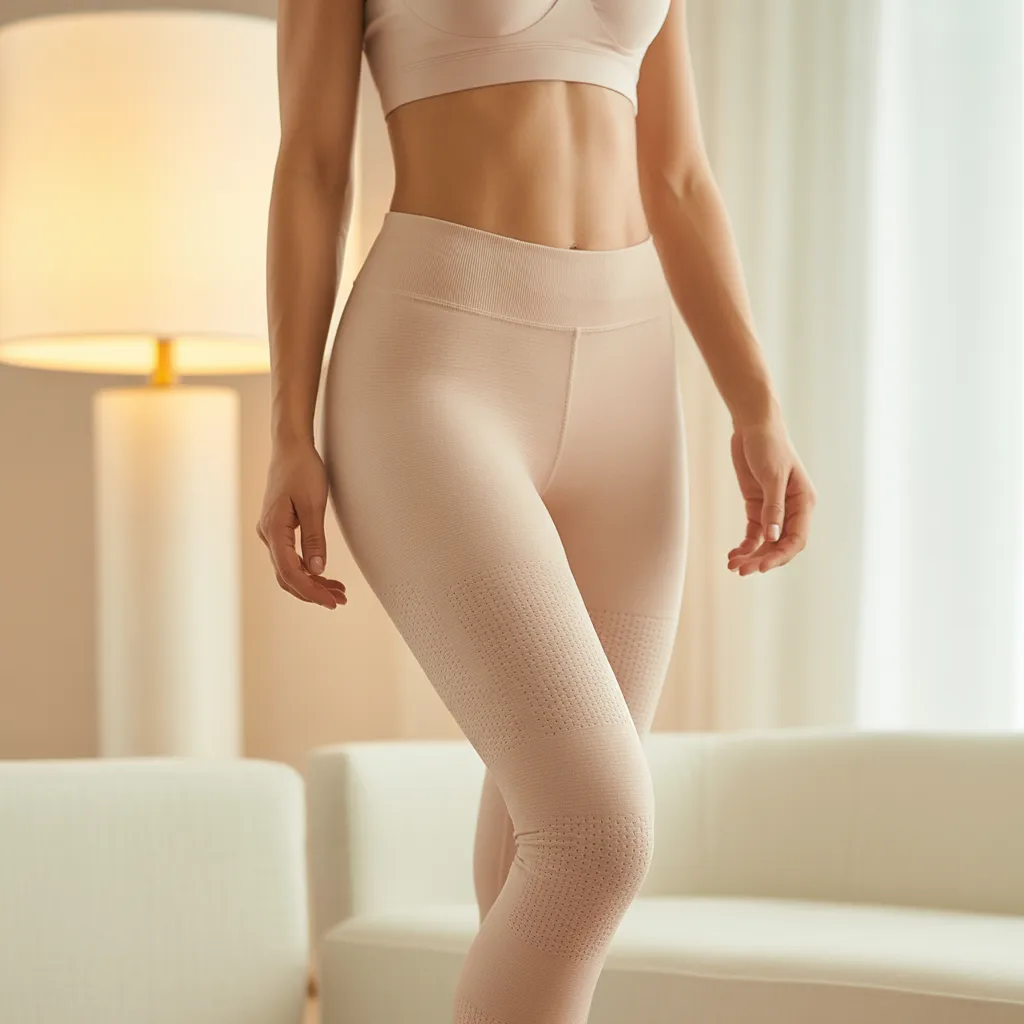
These five are chosen for FA-specific use: uniform compliance (no visible lines), long wear tolerance, and clinically relevant compression levels.
Rejuva Compression Seamless Leggings
Flat-knit construction means no texture visible through fitted uniform fabrics. The 15–20 mmHg range is right for most crew; the seamless finish holds up through full-length rotations without bunching at the knee.
Best for: Seamless under fitted uniforms
Pros
- ✓ 15–20 mmHg compression
- ✓ Seamless flat-knit construction
- ✓ No bunching at the knee
- ✓ Comfortable for long rotations
Cons
- ✗ Limited size availability
SIGVARIS Soft Silhouette Leggings
SIGVARIS's medical credentials mean this is genuine Class 1 compression, not a marketing estimate. The silhouette is clean enough to wear under uniform trousers without visible lines. Sized properly, it doesn't roll down on a 12-hour shift.
Best for: Uniform wear, full-shift compression
Pros
- ✓ 15–20 mmHg graduated compression
- ✓ Invisible under uniform trousers
- ✓ Holds without rolling down
- ✓ SIGVARIS clinical quality
Cons
- ✗ Premium price point
CzSalus Flat Knit Lipedema/Lymphedema Leggings
For crew who deal with more pronounced swelling, or those managing early lipedema alongside their flight schedule, the slightly higher pressure (18–21 mmHg) makes a noticeable difference. Flat-knit structure is more forgiving on swollen legs than circular-knit alternatives.
Best for: Pronounced swelling, early lipedema
Pros
- ✓ 18–21 mmHg compression
- ✓ Flat-knit, forgiving on swollen legs
- ✓ Therapeutic-grade construction
- ✓ Holds up across rotations
Cons
- ✗ Thicker fabric, less invisible under thin uniforms

Leonisa Compression Leggings
A reliable entry point; Leonisa's compression is consistent across sizes. Good choice for crew who want to try compression leggings before committing to a medical-grade option, the fit is comfortable for full-day wear and the waistband doesn't dig in.
Best for: First-time compression users, daily wear
Pros
- ✓ Consistent compression across sizes
- ✓ Comfortable waistband
- ✓ Accessible entry-level price
- ✓ Good for full-day wear
Cons
- ✗ Lighter compression than medical-grade options
CzSalus Lipedema/Lymphedema Leggings (lighter variant)
Lighter compression than the flat-knit version, better for recovery days and post-rotation rest, when you want support without full Class 1 pressure. Some crew wear the lighter variant the day after a long-haul, the firmer version on duty.
Best for: Recovery days, post-rotation rest
Pros
- ✓ Lighter pressure, comfortable for rest days
- ✓ CzSalus quality construction
- ✓ Pairs with firmer version for rotation strategy
- ✓ Comfortable continuous wear
Cons
- ✗ Not firm enough as primary on-duty option
How Flight Attendants Use Them in Practice
Timing matters more than most guides admit. Put them on before you leave the hotel, not at the gate. Your legs are already starting to retain fluid from the previous rotation; waiting until boarding means you're already behind.
During a 10–14 hour flight, you can wear Class 1 compression (15–20 mmHg) continuously without medical risk. Remove them after landing, not mid-flight; the pressure differential when you take them off at altitude can cause a temporary fluid rush that's uncomfortable and counterproductive.
Under uniform? SIGVARIS Silhouette and Rejuva's seamless construction both disappear under fitted trousers. A few crew layer compression knee-highs under compression leggings on particularly long rotations, it's not required, but it's also not excessive for a DXB–SYD or EWR–DXB leg.
Hydrate deliberately. Compression helps, but it doesn't compensate for dehydration; the two work together.
Before Your Next Rotation
If your legs ache after landing, or your shoes fit differently at arrival than at boarding, you're a strong candidate for Class 1 compression. Start with SIGVARIS Silhouette or Rejuva if uniform compliance matters; move to CzSalus Flat Knit if the swelling is more persistent. For the broader picture on compression and crew wellness, ShapeAndSupport.com covers flight attendant wellness in depth.