How to Care for Your Compression Leggings (and Make Them Last Twice as Long)
This article contains affiliate links. We earn a small commission at no extra cost to you.
Why Care Matters More Than With Regular Leggings
Regular leggings are just fabric. Compression leggings are engineered garments: the elastic fibres are woven in a specific graduated pattern that delivers higher pressure at the ankle and decreasing pressure up the leg. That pattern is what makes them work. Damage the fibres and you lose the graduation, and with it, the clinical benefit.
Heat, harsh detergents, and mechanical stress from tumble drying all degrade elastic fibres. The result isn't dramatic, your leggings won't fall apart. They'll just quietly stop delivering the compression they're rated for. You'll still be wearing them, but they won't be doing what you bought them to do.
"Compression leggings rely on graduated elastic fibres woven in a specific pattern to deliver higher pressure at the ankle and decreasing pressure up the leg. Heat above 40°C, harsh detergents, and mechanical stress from tumble drying all degrade these fibres, not visibly, but functionally. The garment won't fall apart; it will simply stop delivering the compression it's rated for. Proper care preserves the graduated pressure that makes compression clinically effective."
Washing: What Actually Works
Hand washing
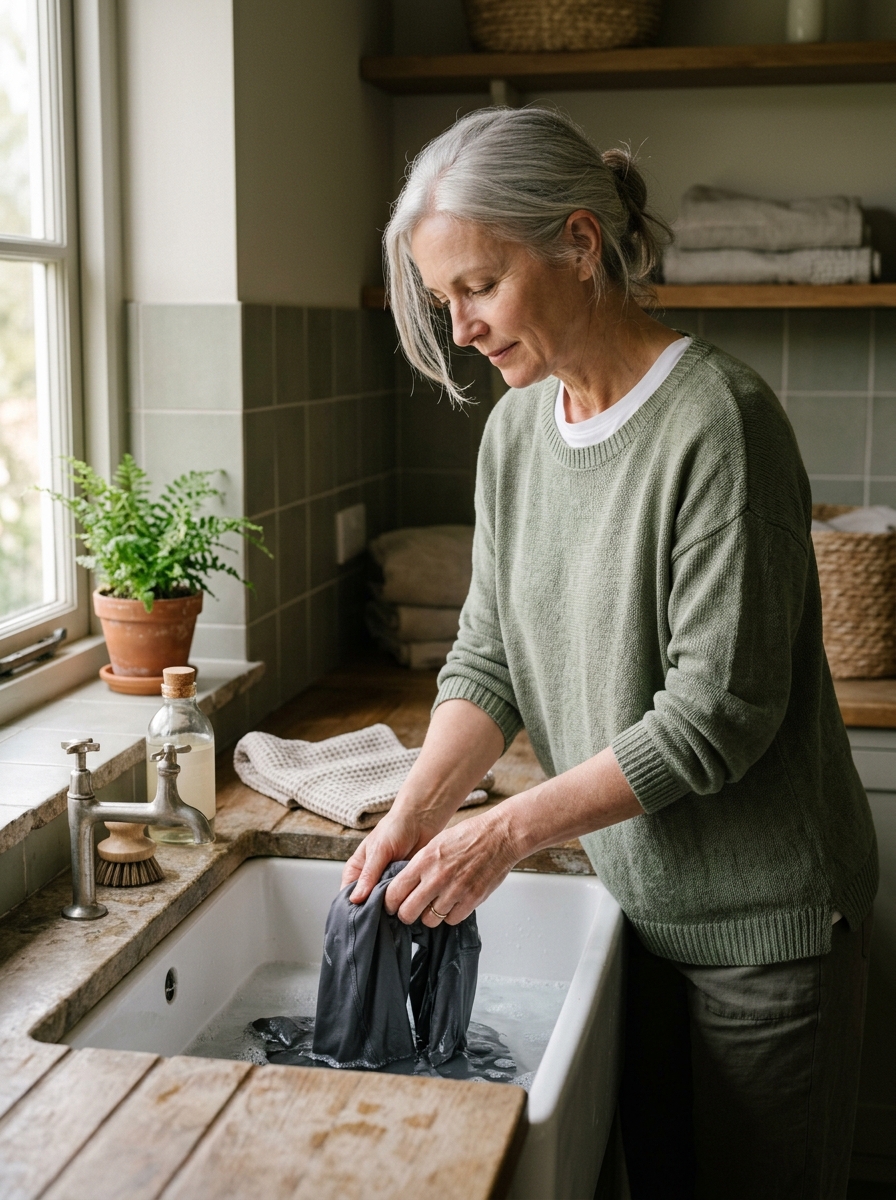
Fill a basin with cool or lukewarm water, 30°C maximum. Add a small amount of mild detergent without enzymes or optical brighteners. Submerge the leggings, gently agitate for a minute or two, then rinse thoroughly in cool water until the water runs clear.
Don't wring them. Roll them in a clean towel to press out excess water, then lay flat or hang to dry. This is the gentlest method and preserves elastic integrity the longest.
Machine washing (when you do it anyway)
Use a mesh laundry bag, always. Set the machine to a cool or delicate cycle at 30°C maximum. Use a mild detergent. Do not add fabric softener; it coats elastic fibres and reduces their ability to stretch and recover.
If your machine has a spin-dry setting, use the lowest RPM available. High-speed spin cycles stress the same fibres you're trying to protect.
What to avoid
Hot water above 40°C, tumble drying at any temperature, enzyme-based detergents, fabric softener, and bleach. Each one degrades the elastic fibres that deliver graduated compression. The damage is cumulative and irreversible, once the fibres are stretched or deformed, no amount of subsequent gentle washing will restore the original compression rating.
Drying and Storage
Never tumble dry compression leggings. The heat inside a tumble dryer, even on a low setting, exceeds the temperature threshold for elastic fibre integrity. One cycle won't destroy them, but the cumulative effect over weeks is measurable compression loss.
Lay flat on a clean towel or hang to dry away from direct sunlight. UV exposure degrades elastic fibres over time, so a shaded indoor spot is ideal. They'll dry within a few hours at room temperature.
For storage, fold rather than roll, rolling can create localised stretch points in the fabric. Store in a drawer away from direct heat sources. Don't leave them balled up in a gym bag for days between washes; body oils and sweat will break down the elastic faster than washing will.
Join our newsletter
Honest guides, honest reviews. No spam, unsubscribe anytime.
How Many Pairs Do You Actually Need?
Two pairs is the minimum for a sustainable rotation. Compression leggings need to be washed after every wear, and they need time to air dry. With two pairs, one is always clean and ready while the other recovers. This alone doubles the effective lifespan of each pair.
If you wear compression daily, for work, clinical reasons, or post-surgical recovery, three pairs is the practical number. It gives you a buffer for drying time and means each pair gets washed roughly every third day instead of daily, reducing cumulative fibre stress significantly.
How to Tell When They've Lost Compression
Compression loss is gradual, which makes it easy to miss. Three checks will tell you where you stand.
The ankle test. Put them on and pay attention to the ankle area. Fresh compression leggings feel noticeably firm around the ankle, that's where graduated pressure is highest. If the ankle feels the same as the calf, the graduation has degraded.
The stretch test. Hold the fabric between your hands and stretch it gently. Fresh compression fabric has a firm, controlled snap-back. Worn-out fabric stretches easily and recovers slowly or incompletely.
The time benchmark. Budget-tier medical brands typically maintain accurate compression for around 50 wash cycles, roughly three to five months of daily use. Premium brands like SIGVARIS are engineered for well past 100 wash cycles. If you're past the expected lifespan and the ankle feels soft, it's time to replace.
Time to Replace?
When compression has faded, the garment is no longer delivering the graduated pressure that makes it clinically effective. Class 1 compression at 15–20 mmHg is the validated range for managing mild to moderate swelling and supporting lymphatic return. (Source: PMC4081237, NCBI)
JOBST ACTIVA Opaque Knee High
Clinical brand, certified 15–20 mmHg, accessible price. Sensible for building a rotation without overspending.
Best for: Budget-to-mid replacement, building a rotation
Pros
- ✓ Certified 15–20 mmHg graduated compression
- ✓ Established clinical brand
- ✓ Accessible price, easy to keep 2–3 pairs
- ✓ Available in multiple sizes
Cons
- ✗ Compression degrades faster than premium tier
- ✗ Less suited to very heavy daily use
SIGVARIS Soft Silhouette Compression Leggings
Medical-grade construction rated by the manufacturer to hold its compression for more wash cycles than standard fabrics. Better cost-per-wear for daily users.
Best for: Daily wearers, upgrade from budget tier
Pros
- ✓ Medical-grade 15–20 mmHg, tested and certified
- ✓ Engineered for consistent daily wear
- ✓ Manufacturer-rated to hold compression accuracy longer
- ✓ Looks like normal activewear
Cons
- ✗ Premium price point
- ✗ Full-length can feel warm in hot weather
One More Thing
If you're deciding whether to replace with the same tier or upgrade, our guide to whether expensive lymphatic leggings are worth it breaks down exactly when premium earns its price and when budget certified is the smarter call.